Showing posts with label STMICROELECTRONICS. Show all posts

4/24/2013

ULN2803A STMicroelectronics Integrated Circuits IC


The circuit diagram of this programmable sequencer could be applied in a number of timing uses. Prior to the start of each interval, an audible tone is generated, and a seven-segment LED display shows the interval number. Prior to the end of that inerval, the buzzer sounds again. IC1 is a 2240 timer/counter device that clocks up to 256 periods, the durations of which are determined by resistor R1 and capacitor C1. The 2240 has its RESET and TRIGGER pins (10 and 11) wired via a push switch S1.The timer is used to operate a memory chip, IC2. The first 8 addressed bits are used by the timer/counter to step through the 256 steps available for each program. The other 6 bits are selected by an external switch network S2 to S7 which permits up to 26 programs, each of 256 steps. The 27C64 has eight outputs, which was enough for a single-digit LED display plus a piezo buzzer.

The ULN2803A is a high-voltage, high-current Darlington transistor array. The device consists of eight npn Darlington pairs that feature high-voltage outputs with common-cathode clamp diodes for switching inductive loads. The collector-current rating of each Darlington pair is 500 mA. The Darlington pairs may be connected in parallel for higher current capability.

Applications include relay drivers, hammer drivers, lamp drivers, display drivers (LED and gas discharge), line drivers, and logic buffers. The ULN2803A has a 2.7-kΩ series base resistor for each Darlington pair for operation directly with TTL or 5-V CMOS devices.




4/18/2013

LM250 Adjustable Voltage Regulators Three -Terminal 3 A


Description:
 
LM250 is  Three -Terminal 3 A Adjustable Voltage Regulators.
 
LM250 Features:
 
●Guaranteed 3A Output Current
●Adjustable Output Down to 1.2V
●Line Regulation Typically 0.005% /V
●Load Regulation Typically 0.1%
●Guaranteed Thermal Regulation Current Limit Constant With Temperature
●Standard 3-Lead Transistor Package


4/17/2013

ULN2803A HIGH-VOLTAGE, HIGH-CURRENT DARLINGTON ARRAYS


The circuit diagram of this programmable sequencer could be applied in a number of timing uses. Prior to the start of each interval, an audible tone is generated, and a seven-segment LED display shows the interval number. Prior to the end of that inerval, the buzzer sounds again. IC1 is a 2240 timer/counter device that clocks up to 256 periods, the durations of which are determined by resistor R1 and capacitor C1. The 2240 has its RESET and TRIGGER pins (10 and 11) wired via a push switch S1.The timer is used to operate a memory chip, IC2. The first 8 addressed bits are used by the timer/counter to step through the 256 steps available for each program. The other 6 bits are selected by an external switch network S2 to S7 which permits up to 26 programs, each of 256 steps. The 27C64 has eight outputs, which was enough for a single-digit LED display plus a piezo buzzer.


The ULN2803A is a high-voltage, high-current Darlington transistor array. The device consists of eight npn Darlington pairs that feature high-voltage outputs with common-cathode clamp diodes for switching inductive loads. The collector-current rating of each Darlington pair is 500 mA. The Darlington pairs may be connected in parallel for higher current capability.

Applications include relay drivers, hammer drivers, lamp drivers, display drivers (LED and gas discharge), line drivers, and logic buffers. The ULN2803A has a 2.7-kΩ series base resistor for each Darlington pair for operation directly with TTL or 5-V CMOS devices.


 HT1621        TEA2025B           ULN2803A         IRFP250N

4/08/2013

Low Power Dual Operational Amplifier LM2904


The LM158 series consists of two independent, high gain, internally frequency compensated Operational Amplifiers LM2904 which were designed specifically to operate from a single power supply over a wide range of voltages. Operation from split power supplies is also possible and the low power supply current drain is independent of the magnitude of the power supply voltage.

Application areas include transducer Amplifiers dc Gain Blocks and all the conventional op amp circuits which now CAN be more easily implemented in single power supply systems. For example, the LM158 series CAN be directly operated off of the standard +5V power supply voltage which is used in digital systems and will easily provide the required Interface electronics without requiring the additional 15V power supplies.

The LM358 and LM2904 are available in a chip sized package (8-Bump micro SMD) using National's micro SMD package technology.

LM2904 pdf datasheet

4/02/2013

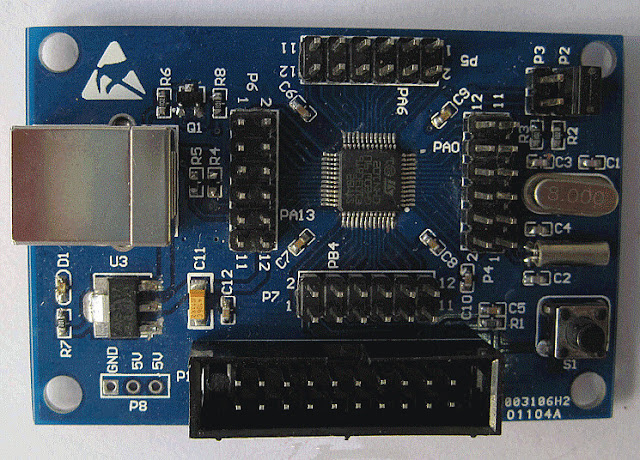
STM32F103C8T6 Performance line, ARM-based 32-bit MCU with Flash, USB, CAN, seven 16-bit timers, two ADCs and nine communication interfaces


The STM32F103C8T6 performance line family incorporates the high-performance ARM Cortex-M3 32-bit RISC core operating at a 72 MHz frequency, high-speed embedded memories (Flash memory up to 128Kbytes and SRAM up to 20 Kbytes), and an extensive range of enhanced I/Os and peripherals connected to two APB buses. All devices offer two 12-bit ADCs, three general purpose 16-bit timers plus one PWM timer, as well as standard and advanced communication interfaces: up to two I2Cs and SPIs, three USARTs, an USB and a CAN.

The STM32F103C8T6 performance line family operates in the −40 to +105 °C temperature range, from a 2.0 to 3.6 V power supply. A comprehensive set of power-saving mode allows to design low-power applications.

The complete STM32F103xx performance line family includes devices in 4 different package types: from 48 pins to 100 pins. Depending on the device chosen, different sets of peripherals are included, the description below gives an overview of the complete range of peripherals proposed in this family.

3/11/2013

UC3842 CURRENTMODE PWM CONTROLLER

The  UC3842  is available in an 8-Pin mini-DIP the necessary features to implement off-line, fixed-frequency current-mode control schemes with a minimal external parts count. This technique results in improved line regulation, enhanced load response characteristics, and a simpler, easier to design control loop. Topological advantages include inherent pulse-by-pulse current limiting.